


When starting or reorganizing a CPA practice, one question often arises: accounting firm LLP vs LLC which one is better? The decision influences the risks and taxes, management flexibility, and compliance. Accountants should consider both choices carefully before forming their business.
Professional service firms are subject to specialized regulations. The nature of entities allowed is often influenced by state licensing boards. Some states need accounting firms to register as professional entities rather than business structures.
LLPs Have Been Popular With Accounting Firms Since Many Years Now. An LLC, commonly known as a Limited Liability Company, has flexible and easy management. They all have their own pros and cons.
We will discuss their legal differences, liabilities, taxes, and how to turn your home into a business. Accounting professionals can learn how LLPs and LLCs work, and pick the entity that will best benefit their firm’s future sustainability and growth.
Importance of LLP and LLC Structures for Accounting Firms
The comparison of accounting firm LLP vs LLC commences with a general understanding of the structure of each. They both protect you from liability, but they do so differently.
An LLP is a partnership form meant for licensed professionals. All partners are safeguarded from an individual debt arising from a partner’s negligence. Nonetheless, each partner still has to take responsibility for their actions.
An LLC is a flexible structure that is like a cross between a partnership and a corporation. It protects the members from commercial liabilities and allows flexible management structures.
| Feature | LLP | LLC |
|---|---|---|
| Ownership | Partners | Members |
| Liability Protection | Protects against other partners’ negligence | Protects against business liabilities |
| Management | Partner-managed | Member or manager-managed |
| Professional Suitability | Common for licensed firms | Often requires professional designation |
Accountancy firms must register as professional entities in many states. In certain places, CPA businesses only make use of LLPs or Professional LLCs.
Before choosing a structure, it is important to understand local regulations. Licensing boards may have additional requirements beyond business filings.
Both offers limited liability for normal business liabilities. But, neither protects them from malpractice liabilities personally.
Factors Related to Liability and Regulations
The accounting firm LLP vs LLC debate comes down to liability protection more than anything else. Though both systems lessen personal exposure, their scope and nuances differ.
An LLP confines liability to the partners. Generally, other partners will not be personally liable for the wrongdoings. Law and accounting firms have long embraced these structures.
An LLC guards its members from business debt. Always a personal exposure issue It’s still the members that are responsible for their own professional mistakes.
Official Licensing Needs
Entity choice is driven by state regulations. Many states require accounting firms to register as a professional limited liability company if taking the LLC route.
A Professional LLC may limit ownership possibility. In certain jurisdictions, only licensed CPAs may serve as members. They assure conformity to professional standards.
Risk management and insurance
Professional liability insurance is must for all entities. Forming an entity will not eliminate malpractice risk. Insurance policies will ensure both firm and client.
Key regulatory issues include
- Approval from State Licensing Board.
- Requirements for registering business entities.
- Rules for owning eligibility.
- Compulsory professional liability coverage.
Serious consequences follow non-compliance with Professional Service regulations in practice You might also lose your license.
Both LLPs and LLCs are required to file annual reports with the state. Compliance upkeep safeguards the company’s legal status.
Through liablility knowledge accountants can make educated decisions. Professional assistance often clarifies state requirements.
Difference Between Taxation & Management
The tax treatment is another critical point in the comparison of accounting firm LLP vs LLC. By default, both are generally subject to pass-through taxation.
In an LLP, the partners directly receive profits. Individual tax returns report partners income. This steers clear of corporate taxes.
An LLC also automatically goes to passthrough taxation. Individual reporting of profits and losses by members. LLCs may choose corporate tax treatment if they wish.
Organizational Framework
Management of LLPs is partner based. Unless agreed otherwise, decisions are joint ones. This structure is well suited to collaborative professional environments.
Flexibility with LLCs. Members can manage directly or appoint managers. The owner is separate to the day to day operations.
Flexibility for Growth and Ownership – LLP vs LLC
LLP Ownership is often restricted to professionals. According to the law of various states, the ownership of LLC may be broader. This can impact scaling decisions.
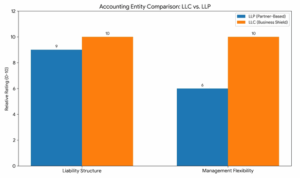
- The LLC offers a maximum score of 10/10 for management flexibility. Additionally, they provide a Flexible Governance Model whereby firms can customize their operating agreements.
- Both offer liability protection but have differentiating factors influencing the ratings. The LLC is rated 10/10 for the Business Liability Shield which offers broad company-level protection. The LLP has a strong score of 9/10 for Partner-Based Protection, shielding partners from each other’s mistakes.
- Many accounting firms may expand or plan to expand across state lines. In this context, an LLC is many times the appropriate entity form because of the flexibility of the entity form and its generally consistent recognition across states.
How to Select an Entity: LLP vs LLC
You need to evaluate several factors before choosing an LLP or LLC. Review your state’s licensing regulations first. Verify which structures are allowed for CPA firms.
Evaluate your company’s growth strategies. If there’s an expectation of expansion or outside capital. Think about management likes and governance style.
Analyze risk of loss. The partnership nature of LLP structure will fit better with the conventional accounting method, although both provide protection.
Think before taking any action – LLP vs LLC
- List the state licensure requirements.
- Management flexibility desired.
- Goals of tax planning.
- Goals for long-term growth.
Consult an attorney prior to filing formation documents. Business compliance risk lowered by professional consulting.
Once you make a decision, get state registration and get the right licenses. File required documents with the Secretary of State and the state board of accountancy.
Ongoing compliance through annual reports and renewing licences. Having records strengthens your firm’s reputation.
The right choice of entity lays the foundation. Having clarity early is better than restructuring later at a higher cost.
Concluding thoughts on accountant LLP vs LLC
When assessing accounting firms, LLP versus LLC depends on regulatory requirements and strategic goals. Both vehicles provide liability protection and tax benefits. Governance style and professional regulations; however, these may determine the best choice.
Professional partnerships were usually served well by LLPs. LLCs provide flexibility and adaptable management models. Each offers advantages in alignment with diverse practice models.
Good planning sets your entity structure for future growth. By understanding liability limitations, tax implications, and compliance obligations, a firm and its partners are protected. Guidance from services like Corporation Center can also help businesses choose the right structure and stay aligned with legal and regulatory requirements.
To sum up, choosing the right entity is not merely a filing choice. It influences the operations, growth, and risk management of your accounting firm. After careful consideration of all the factors, you will be able to choose the structure which supports stability and professional success.