



The beginning of your business in Arizona depends on the right legal structure. Corporate formation in Arizona for-profit corporation formation is a reasonable choice for liability protection, credibility, and capital raising. Most people like doing business with corporations. Throughout the commercial enterprise income is made, giving to shareholders via dividends is the intention within this structural design.
For-profit corporations are not like nonprofits and aim for commercial growth. They are separate legal entities, which means that it is the business, rather than the owner, which owns the assets and liabilities. This separation keeps your personal assets away from most business debts and claims.
To form a corporation in Arizona, you must do more than file. The process involves drafting the Articles of Incorporation, mailing the limit of shares and setting up organization maintenance and compliance. Careful preparation can help you avoid delays and penalties.
A for-profit corporation is just one of the many types of entities. In this guide, we will look at what a for-profit corporation is, the formation process, and how it compares to other types of entities. When you understand the fundamentals, you can firmly build your business for the long term.
Getting Familiar with Arizona For-Profit Corporations
The formation of an Arizona for-profit corporation involves submitting Articles of Incorporation to the ACC. After incorporation, the company is a separate person. The ability to acquire property, enter into contracts and conduct business in its own name, independent of its owners.
Shareholders own the corporation through shares. Corporate Question Control and its Officers will run day-to-day operations. This governing structure creates clear lines of authority and accountability.
Businesses looking to grow or take on outside investment will often choose for-profit corporations. Investors generally prefer corporations as the ownership can be easily transferred through the issue of shares.
| Feature | For-Profit Corporation | Limited Liability Company |
|---|---|---|
| Ownership | Shareholders | Members |
| Management | Directors and officers | Flexible management |
| Stock Issuance | Permitted | Not typical |
| Liability Protection | Limited liability | Limited liability |
Under Arizona corporate law, corporations must keep accurate records and file annual reports. Following the rules help the organization to maintain its reputation.
Because of the flexibility and the ability to scale this structure is favorite among many entrepreneurs. While formal governance appears sophisticated, it makes businesses functionally long-term strong.
Corporate Structure and Filing Needs
The Arizona business filing process needs thorough preparation. State law requires Articles of Incorporation to contain certain particulars. Insufficient information may result in refusal or delay.
Corporate name must be distinguishable from other registered names. It should contain the words, “corporation” or “incorporated” or an approved abbreviation. We are publicly identifying the entity structure.
Additionally, a registered agent must be designated. The agent has a physical address in Arizona that can accept official papers. You must provide an active agent for compliance.
Incorporation Documents Required Contents
The legal foundation of a corporation is defined by its Articles of Incorporation. Such documents usually consist of corporate name, registered agent information and share authorization. The ownership distribution is determined by the number of authorized shares.
It is essential to carefully plan the share structure. Modifications at a later stage might necessitate changes and extra charges. Clear guidance early avoids rework.
Certain companies add extra clauses for director liability or governance rules. These optional clauses allow you to be flexible, but this flexibility is subject to legality.
Governing and organizing after filing
After the approval, business must take internal organization steps. Corporate bylaws are made, and directors are formally appointed. The rules describe how to operate and vote.
Meetings and documentation are essential corporate governance. Meeting minutes should record major decisions Accurate documentation secures liability protection.
Formation Steps include key
- Searching for a business name
- Incorporation Papers Filing.
- Designating a licensed representative.
- We pay state filing fees.
After the establishment of the entity, obtain a federal Employer Identification Number (EIN). It is important for taxes and payment to your employees.
Corporations have to file annual reports with Arizona Corporation Commission. If you don’t comply, you may face administrative dissolution.
Tracking the compliance is helped by filing services. Having this support lessens administrative burdens for early-stage businesses.
Comparative Analysis of Corporations
Entrepreneurs often contrast Arizona for-profit corporation formation with forming an LLC when considering choices. Both structures guarantee limited liability, but their governance and investment flexibility vary.
Corporations have a formal system of management. Directors are elected by shareholders and officers by directors. It maintains a system of accountability.
LLCs allow flexible management. Members can directly manage or appoint managers. Smaller operations find it appealing.
Capital Investment Benefits
Companies may offer shares to get money. This helps to get investors easily. Corporate forms are preferred by venture capitalists.
LLCs distribute membership interests. Other members may need to approve ownership transfers. This can makes investing harder.
Administrative and Tax Issues
Unless making the S corporation election, corporations may face double tax. Profits get taxed at the level of the corporate and again on distribution. LLC typically enjoy pass-through taxation advantages.
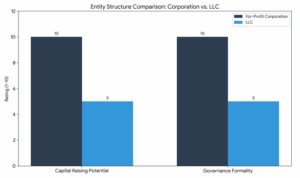
- For-Profit Corporations score a perfect 10/10 for investment flexibility, maximizing your capital raising potential. Offering a diversification of classes of stock makes them the gold standard for attracting venture capitalists and institutional investors.
- Corporate governance needs to be very formal (10/10) with board meetings, minutes and compliance being mandatory. This provides the Structured Oversight that institutional investors often seek for accountability.
- Flexible management captures LLCS’s operational agility. Despite not having formal hierarchy like a corporation, it allows owners to run the business with a lot less administrative hassle and red tape.
A Manual to Create an Corporation
To finalize formation of a for-profit corporation Arizona, organization, and attention to detail are key. Clear step by step instructions reduces risk and speeds up approval.
Conduct a name availability search with the Arizona Corporation Commission. Meet naming requirements.
Take care in preparing the Articles of Incorporation. You will need the consent of a registered agent and details of share authorisation. Make sure everything checks out.
You must file it electronically or by mail. Fast processing is Typical For electronic filing. Submit the appropriate filing fee.
Do these tasks when you get approval
- Conduct a founding board meeting.
- Use corporate regulations.
- Distribute share certificates.
- Get federal tax identification.
Set up a corporate bank account for your business. Keep your personal and business finances separate. This separation allows limit your liability.
Timely file annual reports and ensure accurate corporate records. When you organize your documentation, it protects you from facing compliance challenges.
The formation of the business needs professional Limited Liability Company help. Experienced services track deadlines and minimize filing mistakes.
Establishing a solid legal platform
A for-profit corporation can be formed in Arizona to facilitate business operations. It provides limited liability and encourages the rise of capital. It looks attractive for ambitious Entrepreneurs due to these benefits.
Nonetheless, formation entails discipline and compliance. Ensuring there is a reporting/governance and tax filing compliance in continuation stage of an investment is very critical. Not fulfilling these obligations can endanger your standing.
Before establishing your corporation, examine your expansion strategy and financing requirements. Think strategically about governance and taxes, as careful planning helps ensure long term stability and efficiency. Consulting resources like Corporation Center can also assist businesses in navigating formation requirements and making informed structural decisions.
To sum up, creating a for-profit corporation in Arizona creates a lasting legal structure. By preparing and complying steadily, your organization can ensure sustainable growth and enduring success.