


A Colorado Nonprofit Corporation is an excellent legal structure for an organization created to benefit the public, or provide a charitable, educational, religious, or social purpose. In Colorado, nonprofit corporations provide a formal framework for the achievement of mission-driven goals while providing legal credibility and organizational stability. This structure is commonly adopted by nonprofits, foundations, associations, and community groups.
The separation of the organization from its directors and members is a common reason chosen by founders to establish a nonprofit corporation. Separating the organization from the individual form helps protect people from their organization’s liabilities. At the same time, the nonprofit model fosters trust with donors, grant makers, and the general public.
It’s important to understand how a Colorado Nonprofit Corporation operates before formation. Nonprofits must adhere to certain governance rules, plough surplus funds back into their mission, and comply continuously. Even though nonprofits do not aim to generate profit, leaders must manage them effectively.
This guide to Colorado Nonprofit Corporations details what a nonprofit is, compares them to other structures, and explains how to form one. If you’re starting a new nonprofit or looking at your options, this article is clear and practical.
A Colorado Nonprofit Corporation: Overview and Importance
A Colorado Nonprofit Corporation is anything but a profit-generating entity. But it’s not a business corporation either. Nonprofits do not have shareholders, but do have a board. All excess revenue must be used to further the mission of the organization.
This structure is significant for having legality and continuity. A nonprofit corporation can acquire and manage property, enter into contracts and continue to exist even if the officers or board of directors ceases to act. These features enable success for long missions.
Another advantage is limited liability. Normally, directors and officers are not held personally responsible for the debts of the organization if they act responsibly. This safeguard encourages competent individuals to assume leadership positions.
Nonprofits in Colorado significantly help your local community. They aid the education, healthAcare, arts, environmental cause, and social services. They are looking to go beyond financial metrics and actually measure how they benefit the public.
| Feature | Colorado Nonprofit Corporation | For-Profit Corporation |
|---|---|---|
| Primary Purpose | Public or Charitable Mission – Dedicated to social, educational, or religious goals. | Profit Generation – Focused on maximizing value for owners or shareholders. |
| Ownership | No Owners or Shareholders – The entity is held in “public trust”; no individual “owns” it. | Shareholders – Owned by individuals or entities that hold shares of stock. |
| Use of Profits | Reinvested into Mission – Surplus funds must be used to further the organization’s goals. | Distributed as Dividends – Profits can be shared directly with owners/investors. |
| Governance | Board of Directors – Accountable to the public and the Attorney General. | Board & Shareholders – Accountable to the owners and investors. |
This comparison shows why nonprofit corporations are well-suited for causes.
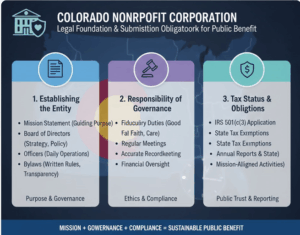
Establishing a Legal Entity
A Colorado Nonprofit Corporation has a legal framework. It starts with drafting a well thought out mission statement in accordance with its purpose. This mission directs how we govern and operate.
A board of directors must manage the organization. Directors oversee strategy, set policy, and carry out fiduciary duties. Officers handle the daily operations under the board’s supervision.
Good governance ensures transparency and accountability. Written rules explain how the organization makes decisions, appoints directors, and conducts meetings.
Responsibility of Governance
Ongoing functions of nonprofit governance. Directors must act in good faith and with reasonable care and in the best interests of the Organization. Not adhering to these obligations can lead to legal risks.
Governance measures should include meetings, proper recordkeeping and money matters. These practices secures the organization and bolsters public confidence.
Tax status, operational obligations and compliance
To operate a Colorado Nonprofit Corporation, you must follow certain rules set by both the state and federal government, and do so continually. Nonprofits must benefit a particular group such as the poor or victims and must be non-profit distributing.
A lot of nonprofit businesses want tax-exempt status. Having tax-exempt status will enable the organization to not pay certain taxes. However, being exempt from tax also has reporting obligations.
Financial and Operational adhearence
Nonprofits must accurately record financial activities and show they spend them properly. When it comes to credibility, transparency is key.
Vital legislation to comply
- Keeping clear financial records.
- Regular adherence to governance documents.
- Leadership ensures that all activities align with the mission.
- Submission of mandated annual reports.
These duty enhance accountability and long-term sustainability.
Relate With Organizational Structure
When considering a nonprofit corporation, it may be helpful to understand how this differs from other options you may consider. Before making a choice, some organizations look at other associations.
- Maximum Public Impact: Nonprofit Corporations get the highest Public Benefit Level at 95% because they invest 100% of surplus back into the mission. This reflects their legal structure which trades all private ownership for a social good.
- The Hybrid Advantage: B Corps blend both benefits and profits through Moderate Private Control and legislation that requires the board to balance financial growth with the public good or ecological benefits.
- Ultimate Private Sovereignty: For-profit corporations as the ultimate in private control where it is the owners that have the ultimate right to direct the company and claim the dividends. The direct public benefit (25%) profile is normally low as they don’t choose to have a higher one.
Nonprofit organization prioritize a societal benefit rather than control. Profits firms provide more control over ownerships, but they lack nonprofit credibility. Unincorporated groups are easier to set up and but offer less protection.
A community arts organization may incorporate as a not-for-profit in order to attract grants. A social goals consulting service could have a for-profit structure to allow for flexibility.
It depends on mission, funding strategy and longer term vision.
Guide on Creating and Organizing a Nonprofit Corporation In Colorado
Make sure you define the mission and all the activities must not detract from your mission. A focused mission helps guide decisions and attract supporters. Selecting a board is important. Select directors with varied skills, commitment, and integrity. Effective leadership fosters adherence and expansion.
Management practices that are beneficial include
- Creating laws and policies that are clear
- Having continuous meetings with the board
- Separating governance from operations
- Finances review consistently
These operations enable the smooth functioning of nonprofits.
It is also important to plan for sustainability. Nonprofits need to build funding plans and assess program effectiveness. Continuous planning benefits our mission.
Establishing a Colorado nonprofit for impact
Organizations dedicated to the public good often choose a Colorado Nonprofit Corporation. Corporation Center Supporting credibility, accountability, and long-lasting impacts.
Founders of an organization can build resilient organizations by understanding governance requirements, compliance duties and strategic planning. Nonprofit firms comprise still allow overall objective.
A Colorado Nonprofit Corporation is among the best-organized and most respected options for individuals and groups looking to serve their communities.