



Professionals in Arizona must meet legal requirements to launch their own businesses. It is important to understand the Arizona professional formation requirements before filing any documents with Arizona corporate agencies. Any physician, attorney, accountant, architect, and other regulated practitioner who wants to operate through a professional entity must comply with these rules.
Professional firms have to comply with both the law of companies and law of licensing unlike ordinary businesses. Generally ownership is limited to holders of valid Arizona licenses. This means that everything will be under control of experts.
If these formation requirements are not followed, approval can be delayed or compliance issues can arise later. Businesses should structure their entities properly to avoid complexity. Having proper planning will protect not only the business but the public as well.
This guide explains the eligibility criteria, filing requirements, structural differences, and practical steps. A thorough understanding of the requirements allows you to set up your professional entity with clarity and confidence.
Requirements for Professional Formation in Arizona
The phrase Arizona professional formation requirements refers to laws governing professional corporations and similar entities. Industries must be licensed for accountability. Metadata. While professional licensing boards impose eligibility standards, the Arizona Corporation Commission oversees corporate filing.
A licensed service must be rendered through a professional entity only. It cannot function as an unlimited business entity. The articles of incorporation must state the professional purpose.
Owner restrictions are critical for compliance. Those with the proper Arizona license can own shares of a professional corporation. Unregistered people cannot influence licensed behavior because of this.
| Requirement | Professional Corporation | Standard Corporation |
|---|---|---|
| Ownership Eligibility | Licensed professionals only | No license required |
| Purpose Statement | Specific professional service | General business purpose |
| Regulatory Review | May require board approval | Limited to corporate review |
| Compliance Oversight | Corporate + licensing authority | Corporate authority only |
These added safeguards protect clients and maintain professional integrity. Arizona law makes getting caught a priority.
Experts should know compliance does not stop after filing. Annual reports, license renewals, and governance regulations must be consistently complied with. Long-term stability is supported by strong organizational planning.
Required legal structure and key
It takes more than the submission of basic paperwork to meet the requirements of Arizona licensing entity. Eligibility, naming, and governance criteria must be satisfied by professionals.
Ensure all the listed shareholders hold an active Arizona license before filing. Licensing boards may require documentation confirming this status. Verify proper details to avoid FW denial.
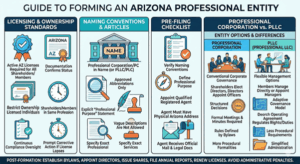
Standards for Licenses and Ownership
Professional corporations restrict ownership to only licensed individuals. Generally shareholders must hold same professional license. In this way, every individual will be accountable.
A shareholder whose license lapses may become ineligible to hold. In order to stay compliant, prompt updates and corrective action is required. The oversight of licensing continues throughout the corporation’s existence.
The formation documents of an Arizona Professional Entity must usually disclose license information. Transparent information enables regulatory oversight.
Names and Incorporation Articles
The name of the company must reflect professionalism Typically needs the words “Professional Corporation” or an approved abbreviation. This distinction is of use to clients and regulators.
The articles have to specify the exact professional services provided. Vague Descriptions Are Not Enough. Arizona needs more clarity on what practice means.
Confirm the following before you are ready to file
- Following naming conventions.
- Statement of professional purpose.
- Hire a qualified registered agent.
An Arizona registered agent has to have a physical address. This agent will receive official mail. And service or your legal documents.
After proposal approval, the organization proceeds Establishing bylaws, appointing directors and issuing shares. Shareholders often hold a license.
Reporting requirements in effect. In order to maintain good standing, annual reports must be filed. The renewals for licensing must also remain current.
Following these standards closely prevents administrative penalties. Formation specialists are called for accuracy and efficiency by many professionals.
Contrast Professional Corporations and PLLCs
Evaluating entity options also entails understanding Arizona professional formation requirements. Professionals can opt for a professional corporation or a professional limited liability company.
Business debts are protected under both structures. Yet, there is a very big difference in the governance and the tax treatment.
Professional corporations adhere to conventional corporation governance. Shareholders choose the directors and directors appoint officers. This model facilitates structured decisions.
PLLCs enable flexible management. Members have the option to manage directly or appoint managers. This flexibility is preferred by smaller practices.
Management and Structure
Professional corporations must hold meetings and keep minutes. Rules define corporate bylaws. These formalities enhance accountability.
PLLCs require less procedural requirements. Operating agreements regulate member rights and responsibilities. This can make administrative tasks easier.
Tax and Financial Factors
When a corporation does not elect S status, it may face double taxation. By default, PLLCs opt for pass-through tax rules. 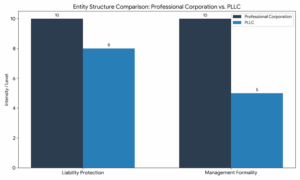
- Professional Corporations operate under a formal corporation governance model, while the PLLC provides for a more adaptable model with more operational flexibility.
- While both offer liability protection, Professional Corporations emphasize structure while PLLCs are more fluid.
- Practices that are larger and those with a desire for outside investment tend to benefit from the intentional governance and predictability of a Professional Corporation.
Guide to Compliance Steps
There is a structured approach to meeting Arizona professional formation requirements. Organized steps reduce delays and help you comply.
Start by verifying licensing eligibility. Every shareholder should have a professional license. Check with the relevant regulatory board.
You can reserve your business name through the Arizona Corporation Commission, but you must follow professional naming standards. Different names avoid conflicts.
File the Articles of Incorporation and perform. Add a clear professional purpose statement. Add required licensing confirmations.
- Get organized after you get approved
- Establish organizational regulations.
- Conduct the first board meeting
- Only licensed professionals may be issued shares.
- Get a federal Employer Identification Number.
Set up a business banking account under the entity’s name. Keep your personal and business finances separate. Prevent liability by becoming financially separate.
Your annual filings should be on time. Renew your professional licenses on time, because missing deadlines can jeopardize your company’s good standing.
Preserve complete business records. Record meetings, monetary resolutions, and ownership modifications. Structured documentation streamlines audits and compliance assessments.
Formation services are often relied upon by professionals. These providers supervise deadlines and verify filings for correctness. Their help lessens the administrative burden.
In closing, professional entity compliance
If a licensed professional intends to incorporate, understanding Arizona professional formation requirements is vital. These standards protect both the public and the profession. Corporation Center helps organizations manage formation requirements and maintain proper compliance.
Before you file, consider your goals. Think about how taxes affect government capacity. Planning always brings stability.
To sum up, with proper preparation, formation can become less cumbersome and efficient. Following rules laid down by the licensing authorities helps you build strong legal protection. Following the rules today will safeguard your career tomorrow.