


When companies in Connecticut decide to function in a socially responsible way by not distributing profits to shareholders, they frequently set up a Connecticut Nonstock Corporation. These types of businesses, unlike regular ones, do not offer stocks or pay dividends to their owners. As a result, they become the runners of nonprofit, charitable, educational, or community sectors.
The Connecticut Nonstock Corporation setting is very suitable for any group to continue their work with the protection of limited liability while accomplishing goals that are advantageous to the society. Without this kind of structure, the development of nonprofit organizations may be at risk since they would lack the necessary legal recognition to be eligible for grants, obtain tax-exempt status, or comply with state laws.
Such an article serves as an extensive manual about Nonstock Corporations in Connecticut by explaining their function, legal stipulations, benefits, differences from other entities, and the procedure of setting up one.
Understanding the Connecticut Nonstock Corporation
A Connecticut Nonstock Corporation is a business entity that is created under the Connecticut Business Corporation Act with the features necessary for nonprofit organizations. The main difference of such a corporation is that it has no stockholders.
Nonstock Corporation Main Features
- No Stock Issuance: The company is not divided into shares, but it can have members.
- Purpose-Driven: The company is mainly used for the above-mentioned purposes under the nonprofit sector.
- Limited Liability: Gives the directors and members shield from personal responsibility for the debts of the corporation.
- Tax Benefits: If they fulfill the conditions, they can be exempt from both federal and state taxes.
Features of a Connecticut Nonstock Corporation
| Feature | Description | Benefit to Organization |
|---|---|---|
| Ownership | No shareholders; may have members | Focuses on mission, not profit |
| Purpose | Charitable, educational, social, or community | Ensures alignment with nonprofit goals |
| Liability Protection | Directors not personally liable for debts | Safeguards individual assets |
| Tax Status | May qualify for 501(c)(3) designation | Reduces tax burden |
This structure ensures that resources are directed toward community goals rather than shareholder profits.
Legal and Operational Aspects
Operating a Connecticut Nonstock Corporation requires meeting state regulations and maintaining compliance.
Formation Requirements
- Articles of Incorporation: These should be submitted to the Connecticut Secretary of State.
- Purpose Statement: Describe the objectives of the nonprofit clearly.
- Registered Agent: Identify an agent to receive the service of the process.
- Bylaws: Specify the rules of governance, rights of the members, and obligations of the board.
Governance Structure
The management of a nonstock corporation is generally the responsibility of a board of directors. Even though it may have members, the board is the one that has the final decision.
Compliance Obligations
- Filing an annual report with the state.
- Conforming to IRS requirements to maintain tax-exempt status.
- Recording proper minutes of meetings and financial statements.
Liability and Tax Considerations
A nonstock corporation structure is a liability-safe vehicle for individual members and directors. Besides, it lays the groundwork to 501(c)(3) status which opens up the way for exemptions of both federal and state taxes.
Comparing Nonstock Corporations with Other Business Structures
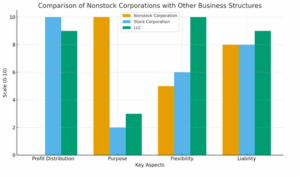
A nonstock corporation is different from a stock corporation and other nonprofit structures mainly in the following aspects.
Nonstock vs. Stock Corporations
Stock corporations are structured to make profits for shareholders. On the other hand, nonstock corporations make the decision to reinvest the surplus in the realization of their mission.
Nonstock vs. LLCs
LLCs may be attractive because of their flexibility and limited liability feature but normally, they are for-profit entities. Nonstock corporations are the only ones that can be established for the non-profit sector.
Step-by-Step Guide to Forming a Connecticut Nonstock Corporation
Forming a nonstock corporation needs planning and several steps to be done.
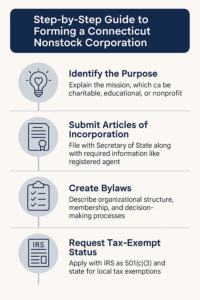
Identify the Purpose
Explain the mission of the society which can be charitable, educational, or nonprofit.
Submit Articles of Incorporation
File the paper to the Secretary of State, as well as the information that is necessary like the registered agent.
Create Bylaws
The company bylaws should describe the organization, the membership, and the ways of decision-making.
Request Tax-Exempt Status
Make an application with the IRS to be recognized as 501(c)(3) and then with the state for local tax exemptions.
Why Form a Connecticut Nonstock Corporation?
The Nonstock Corporation in Connecticut is the foundational structure that is necessary for the development of the organizations that are committed to the nonprofit objectives. It gives security to the members and directors against the risk, it facilitates the tax exemption, and it assures the legal recognition.
Such a framework allows entities to perform a wide range of activities typical of education, healthcare, religion, or community support sectors. In contrast to profit-making enterprises that can be called stock corporations, nonstock corporations are the ones that dedicate all resources to the realization of their mission.
At Corporation Center, the decision to set up a nonstock corporation in Connecticut is more like a strategic step to ensure the organization’s viability in the long run while at the same time accomplishing the public good rather than just legal formalities.